
Central New York Psychiatric Center Overview
Central New York Psychiatric Center is operated by the New York State Office of Mental Health at the Marcy campus in Oneida County. The OMH facility page describes it as a secure inpatient correctional and mental-health system that provides care and treatment to people incarcerated in state and county correctional systems. Its role is different from the Oneida County Correctional Facility. The county jail publishes a current custody list. Central New York Psychiatric Center does not publish a jail-style roster of patients or detainees.
The OMH page states that Central New York Psychiatric Center is the only statewide Correctional/Mental Health system in the United States fully accredited by the Joint Commission. It operates a secure inpatient facility in Marcy and also runs a broader correctional mental-health network. The research found 28 outpatient clinics, 15 satellite units with 205 crisis beds, 781 Intermediate Care Program beds, and clinic services to approximately 8,500 inmate-patients in a DOCCS population described by OMH. The official facility page did not state a separate Marcy secure inpatient bed count.
The facility-specific screenshot source is the official OMH Central New York Psychiatric Center page.
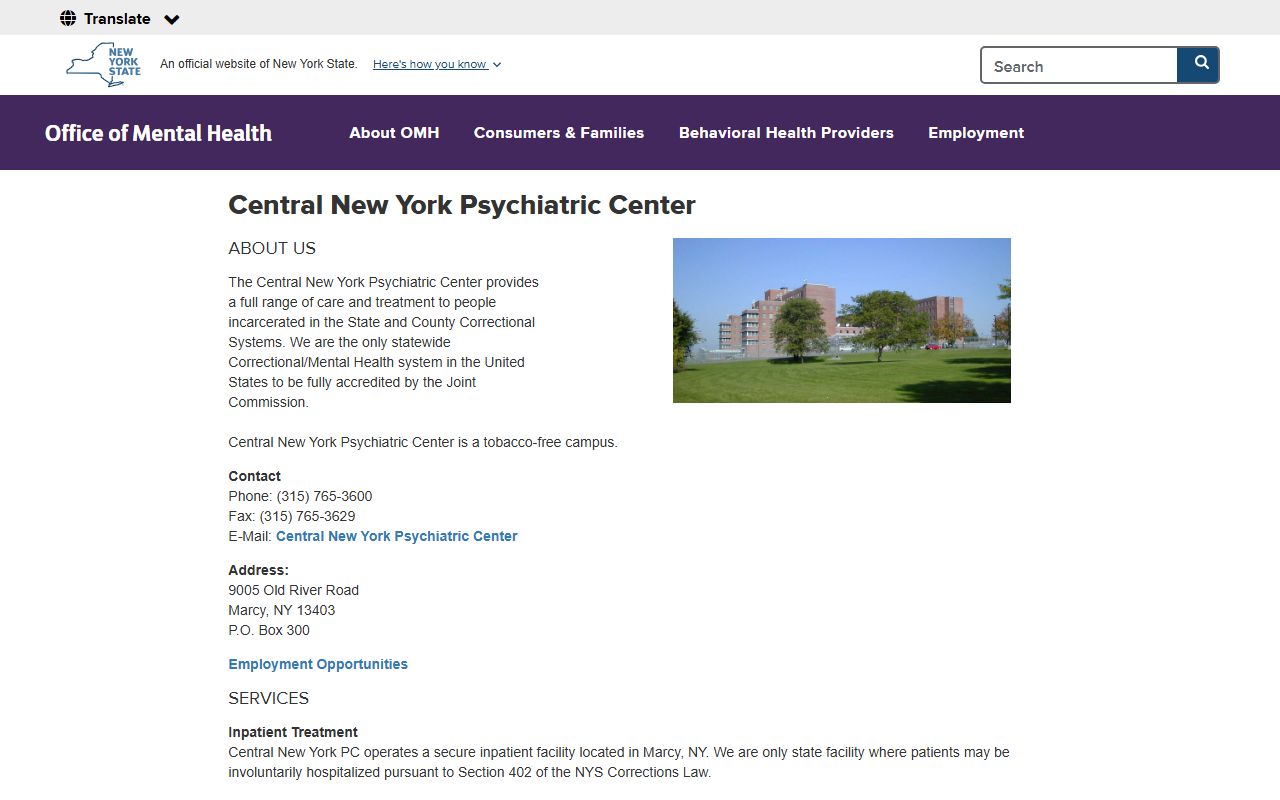
The screenshot confirms that the source is an OMH facility page, which is important because the lookup and privacy rules are not the same as a sheriff jail roster.
Central New York Psychiatric Center Population
Central New York Psychiatric Center serves correctional and forensic populations rather than a normal local jail population. The research identifies several groups: people from the statewide DOCCS population, convicted sentence-serving county jail inmates who need psychiatric hospitalization, pretrial detainees from 25 designated upstate county jails who require inpatient hospitalization, and people committed for restoration services under CPL 730. A person may have started in Oneida County jail, another county jail, or state prison before being moved into OMH secure inpatient care.
The official OMH page gives system-level capacity details, not a public daily census for the Marcy inpatient facility. That difference should not be filled with unofficial numbers. The safest capacity statement is that OMH documents the broader network as including 15 satellite units with 205 crisis beds and 781 Intermediate Care Program beds, while the research did not locate a specific current public bed count for the Marcy secure inpatient center.
| Population Served | Lookup Boundary | Research Basis |
|---|---|---|
| State prison population needing care | DOCCS custody may be searched through DOCCS, but OMH treatment details are private | OMH CNYPC page |
| Convicted county jail inmates needing hospitalization | County jail roster may show prior custody, not current OMH patient details | OMH CNYPC page |
| Pretrial detainees from designated upstate county jails | Court or jail channels may confirm case status, not clinical records | Correction Law 508 research note |
| CPL 730 restoration cases | Court records may show the order, while treatment records remain restricted | CPL 730 research note |
Central New York Psychiatric Center Lookup
There is no public Central New York Psychiatric Center roster comparable to the Oneida County Sheriff's inmate list. For a person who may be in county jail, start with the sheriff's roster or call jail records. For a sentenced state prisoner, use the New York DOCCS incarcerated lookup, which searches by last name with optional birth year, DIN, or NYSID. For a person transferred to Central New York Psychiatric Center for inpatient OMH care, public confirmation is much more limited because the facility is a secure hospital serving correctional and forensic patients.
Public search should be framed as a custody-system check rather than a patient lookup. If the person began in Oneida County jail, the jail roster may show current jail custody only. If the person is no longer listed, the next steps are the jail records unit, the court record for the case, DOCCS if the person was sentenced to state prison, and OMH contact channels only when an authorized family member, attorney, or agency has a proper reason to ask. Clinical details should not be expected from public records.
- Check whether the person is still in the Oneida County Correctional Facility before assuming an OMH transfer occurred.
- For sentenced state custody, search DOCCS by last name, DIN, or NYSID and confirm whether the person is in state custody.
- For a pending criminal case, check court channels for competency, restoration, or hospitalization orders where public access is allowed.
- Contact Central New York Psychiatric Center directly only for appropriate facility routing, authorized contact, or official agency business.
Note: A secure OMH treatment facility does not publish the same public fields as a sheriff jail roster.
Central New York Psychiatric Center Contact
The official contact information in the research comes from the OMH facility page. The address is on Old River Road in Marcy, near other state correctional and secure-treatment facilities. That campus context can cause confusion because Mid-State Correctional Facility and STARC-Oakview also use Old River Road and a Marcy mailing address. Central New York Psychiatric Center should be contacted as an OMH facility, not as a county jail desk or DOCCS prison records office.
Central New York Psychiatric Center
9005 Old River Road, P.O. Box 300
Marcy, NY 13403
(315) 765-3600
Fax: (315) 765-3629
Use the facility phone for OMH facility routing. Use the county jail records number for Oneida County jail custody questions, and use DOCCS for sentenced state-prison locator questions. For public court status, court records may be the better source than an OMH phone call because court orders, competency proceedings, or case calendars are handled by the court system.
Central New York Forensic Holds
The research identifies three legal routes that explain why people from correctional systems may be served by Central New York Psychiatric Center. Correction Law 402 is tied to involuntary hospitalization of people in correctional custody, and the OMH page states Central New York Psychiatric Center is the only state facility where patients may be involuntarily hospitalized under that section. Correction Law 508 is tied in the research to inpatient services for pretrial detainees from designated upstate county jails. CPL 730 covers restoration services for defendants found incapacitated to proceed in a criminal case.
These laws do not create a public inmate roster. They explain the route by which a person may move from jail or prison custody into secure inpatient psychiatric care. A court record may show a competency order or case status. A jail or prison locator may show custody before or after transfer. OMH treatment and clinical records are a separate category and are not published like booking charges, bail status, or jail housing information.
- Correction Law 402
- A New York correctional law route tied to involuntary hospitalization from correctional custody.
- Correction Law 508
- A research-identified route for inpatient services for pretrial detainees from designated upstate county jails.
- CPL 730
- The criminal procedure framework for competency and restoration when a defendant is not fit to proceed.
- Forensic patient
- A person receiving mental-health services within a criminal court or correctional custody context.
Central New York Psychiatric Center Visits
The research did not locate a public jail-style visitation schedule for Central New York Psychiatric Center. That is expected for a secure OMH hospital. Visits, calls, and contact rules can depend on patient status, security level, treatment needs, court orders, and authorized-contact rules. The county jail's GettingOut video visit process does not apply to CNYPC, and DOCCS prison visiting schedules do not automatically apply either.
When a person may be connected to a CNYPC case, the practical contact sequence should be narrow and factual. Confirm the underlying custody system first. Then use attorney, court, or agency contact routes where appropriate. Family contact may require facility approval and identity verification. Public visitors should not travel to Old River Road expecting a county jail lobby visit.
| Question | Likely Source | Important Limit |
|---|---|---|
| Is the person in Oneida County jail? | Sheriff inmate list or jail records | Current county jail custody only |
| Is the person in state prison custody? | DOCCS locator | Does not disclose OMH clinical records |
| Is there a competency or restoration order? | Court record channels | Sealing and confidentiality may apply |
| Can a visit or call occur? | OMH facility contact | Depends on authorization and facility rules |
Central New York Psychiatric Center Mail
The research does not provide a public CNYPC commissary, money-deposit, or mail-format page like the Oneida County jail mail page. That absence is part of the facility distinction. The Oneida County jail uses a Digital Mail Center and requires booking-number formatting. DOCCS prisons use state prison mail, phone, and deposit systems. Central New York Psychiatric Center is an OMH secure inpatient facility, so mail and contact questions should be confirmed with the facility rather than borrowed from either jail or DOCCS rules.
For a person still in jail, use the sheriff's mail and money rules. For a person in state prison, use DOCCS mail, phone, and deposit rules. For a person at Central New York Psychiatric Center, call the facility for approved contact procedures and do not assume public inmate services are available. The difference is especially important where the person has a mental-health court order, restoration status, or clinical restriction.
| Custody Setting | Mail or Money Channel |
|---|---|
| Oneida County jail | Sheriff mail page and jail commissary contacts |
| DOCCS prison | DOCCS visitor, phone, and account-deposit rules |
| CNYPC OMH inpatient care | Confirm with Central New York Psychiatric Center directly |
Central New York Psychiatric Center Intake
Central New York Psychiatric Center intake is not a street-arrest booking process. A county jail booking at Oneida County Correctional Facility starts with pat frisk, securing-order review, suicide-prevention screening, Jail Management System entry, and classification. CNYPC intake follows from correctional, forensic, or court-driven referral into OMH secure inpatient care. The public research supports that distinction but does not publish an operational admissions checklist for CNYPC.
For a reader trying to trace a person, the timeline may begin with arrest and jail booking, then a court competency issue, medical or mental-health referral, or state correctional need. Once OMH care begins, clinical and treatment details fall outside ordinary jail roster access. That makes the court record, attorney contact, jail records unit, DOCCS locator, and OMH contact point complementary rather than interchangeable.
About Central New York Psychiatric Center
Central New York Psychiatric Center is one part of Oneida County's unusually dense corrections and secure-treatment landscape. The county includes the sheriff jail in Oriskany, three DOCCS prisons, CNYPC, and STARC-Oakview. CNYPC sits in the state mental-health system, but it serves correctional populations from both state and county systems. That is why ordinary inmate-search wording can be misleading. A person connected to CNYPC may still have a criminal case, a jail history, or a prison sentence, yet the public lookup path is not a CNYPC inmate list.
The safest public-record approach is to identify the custody system first and then use the proper channel. Oneida County jail records answer county custody and bail questions. DOCCS answers state-prison locator questions. Court records may show case status or certain orders when public. OMH handles facility contact and secure inpatient care, with privacy limits that should be expected from a mental-health provider.
Note: Confirm custody and visit authorization through the proper jail, court, DOCCS, or OMH channel before traveling.