
Oneida County Court Records After a Jail Arrest
After a Oneida County arrest, the person may be booked into the Oneida County Correctional Facility in Oriskany. The Sheriff's Admissions Unit checks the commitment or securing order, records the arresting agency, officer, and charges in the Jail Management System, and the Jail Records Unit enters court appearance dates. Those booking entries are useful custody records, but they are not the final criminal court record. The court record begins to take shape when the prosecution files accusatory documents and the case is placed before a local criminal court, county court, or another court with jurisdiction.
The Oneida County District Attorney is the county prosecutor for criminal cases. The office states that 19 Assistant District Attorneys cover 45 village, town, city, and county courts. That local spread matters because court records after an arrest may sit in a city court, town or village justice court, Oneida County Court, or a later County Clerk file, depending on the charge and case path. For the custody side, use jail inmate records. For booking-photo questions, use jail mugshots. For filed charges, appearances, warrants, bail orders, and case outcomes, use the court-record channels below.
How to Find Oneida County Court Records After an Arrest
Start with the New York Unified Court System WebCriminal portal when the need is a pending criminal case or a future appearance date. The portal presents search modes for Case Identifier, Defendant, and Court Calendar. It is not the Oneida County jail roster and it is not a statewide fingerprint criminal history. It is a court case-information channel, useful when the case is active in a covered court and the search terms match the court's record.
- Open the New York WebCriminal portal and choose the search mode that fits the information available.
- Search by defendant name, case identifier, or court calendar when the court and date are known.
- Compare the result to the jail booking record, because names, dates of birth, and charge wording can vary between systems.
- Read each charge line for level, statute text, next appearance, disposition, or other available case status.
- If the WebCriminal search does not locate the file, use the Oneida County Clerk criminal-file process for unsealed records.
The Oneida County Clerk states that criminal files are not searchable through the public record website because they may contain confidential information. Unless sealed, criminal files can be accessed on a computer terminal in the County Clerk's office. A criminal-file search request may be made by submitting the person's name and the time frame to be searched. The County Clerk says processing may take up to 24 hours, with a search fee for each file searched and additional copy fees if the search produces a hit.
The County Clerk's criminal-actions instructions are published at oneidacountyny.gov/departments/county-clerk/courts/ and explain why the county's public records website is not the criminal-file search tool.
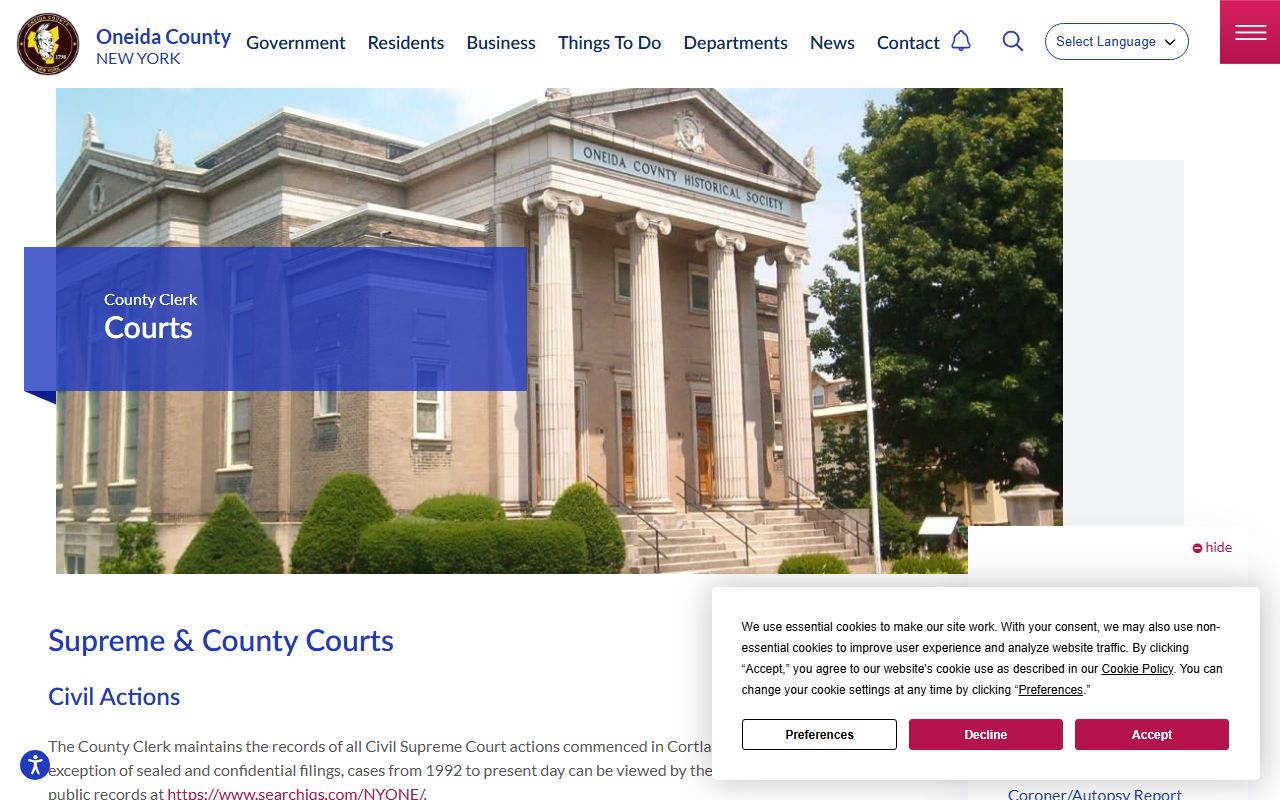
That source is most useful after a WebCriminal search fails, a file is older or closed, or a person needs an unsealed criminal case file reviewed at the County Clerk's office.
| Search Channel | Useful Fields | Best Use | Limit |
|---|---|---|---|
| WebCriminal Case Identifier | Case or docket identifier | Known pending case lookup | Identifier must match the court record |
| WebCriminal Defendant | Defendant name | Finding criminal court records after an arrest | Coverage and spelling can affect results |
| WebCriminal Court Calendar | Court, date, calendar mode | Future appearance checks | Calendar information is not a full criminal history |
| County Clerk Request | Name and time frame | Unsealed criminal file search | May take up to 24 hours and fees apply |
| OCA CHRS | Exact name and date of birth | Statewide criminal-history search | $95 exact-match search, not a jail roster |
| DCJS RAP Sheet | Fingerprints | Official fingerprint criminal history | Different from public case lookup |
How Charges Get Filed After an Arrest: Complaint, Information, and Indictment
Booking charges tell why someone entered custody. Charging documents tell what the court case is built on. In Oneida County, an arrest may begin with a police complaint or other accusatory instrument in a local criminal court. The District Attorney can later continue, amend, reduce, add, dismiss, or present charges for indictment, depending on the evidence, court level, and offense category. This is why court records after a jail arrest should be read as a moving case file, not as a fixed copy of the initial booking text.
| Document | What It Does | Where It Fits | What to Check |
|---|---|---|---|
| Complaint | Accuses the defendant and starts or supports prosecution | Often early local criminal court stage | Charge wording, arrest date, court, next appearance |
| Information | Supports prosecution with sworn factual allegations | Common in misdemeanor and local-court practice | Whether the case moved beyond the initial complaint |
| Felony Complaint | Starts felony prosecution before indictment or reduction | Early felony stage | Whether charges were held for grand jury or reduced |
| Indictment | Grand jury accusation for felony prosecution | County Court felony track | Indictment counts, charge level, arraignment, disposition |
| Superior Court Information | Felony prosecution document used in qualifying cases | Often tied to waiver or negotiated resolution | Plea terms and final conviction charge |
Charge Status in Court Records After an Arrest
Charge status is the reason court records are more reliable than a booking row for case outcome. The jail roster can show the charge used for admission or custody. The court file shows whether that charge is pending, was changed, was dismissed, became a conviction, or was replaced by a different count. The Jail Records Unit also updates charges after court appearances, but a court file or court portal remains the better source for the legal status of the prosecution.
| Status | What It Means | Why It Matters |
|---|---|---|
| Pending | The charge has not reached final disposition. | Future court dates, bail conditions, and warrants may still change custody. |
| Amended | The charge text, count, or statutory basis changed. | The filed court charge may no longer match the booking charge. |
| Reduced | The case continues on a lower charge or lesser offense. | A felony booking can become a misdemeanor case or a lesser count. |
| Dismissed | The court ended that charge without conviction. | Dismissal may affect public access, sealing, and background-check interpretation. |
| Indicted | A grand jury returned felony counts. | The case may move from local court toward County Court felony proceedings. |
| Convicted | The defendant was found guilty or entered a guilty plea. | This is an outcome, not merely an accusation. |
Bail, Release, and Court Orders After an Arrest
Release after a Oneida County arrest depends on the court's securing order and any holds. New York Criminal Procedure Law Sec. 510.10 describes the court's release choices, including recognizance, non-monetary conditions, bail where legally available, and remand where authorized. Criminal Procedure Law Sec. 530.40 provides release and bail rules after arraignment or later proceedings. New York bail reform means a money amount is not automatic for every charge, and many less-serious charges require release on recognizance or non-monetary conditions unless another rule applies.
The Sheriff's contact page lists Records & Bail at (315) 765-2251. The Jail Records Unit processes bails and bonds received at the correctional facility, verifies paperwork before release from the facility or court, and releases the person in the Jail Management System when release is confirmed. A person can still remain in custody after bail is posted if another hold exists, such as a parole hold, federal detainer, out-of-county warrant, immigration issue, or state-prison transfer status.
| Release Term | How It Works |
|---|---|
| Recognizance | The defendant is released on a promise to return to court. |
| Non-monetary Conditions | The court orders conditions that do not require posting money bail. |
| Bail | Money or bond may be set for bail-eligible qualifying offenses. |
| Remand | The court orders custody without bail where authorized by law. |
| Hold or Detainer | Another court or agency blocks release even if the local charge changes. |
Warrants That Lead to an Arrest and Court Records
The Oneida County Sheriff's active warrants list is a separate public channel from the jail roster and court file. Visible fields include Name, Sex, Race, Age, City, Court, Description, and Updated. The list instructs callers who know a listed person's current location to call (315) 765-2232, and the Sheriff's contact page also lists Warrants at that number. Warrant entries can identify the issuing court, such as Oneida County Court, Oneida County Family Court, Sherrill City Court, or Rome City Court.
The public warrant list is available from the Sheriff's Office at sheriff.oneidacountyny.gov/quick-links/warrants-list/ and should be read as an active-warrant channel, not a final court disposition list.
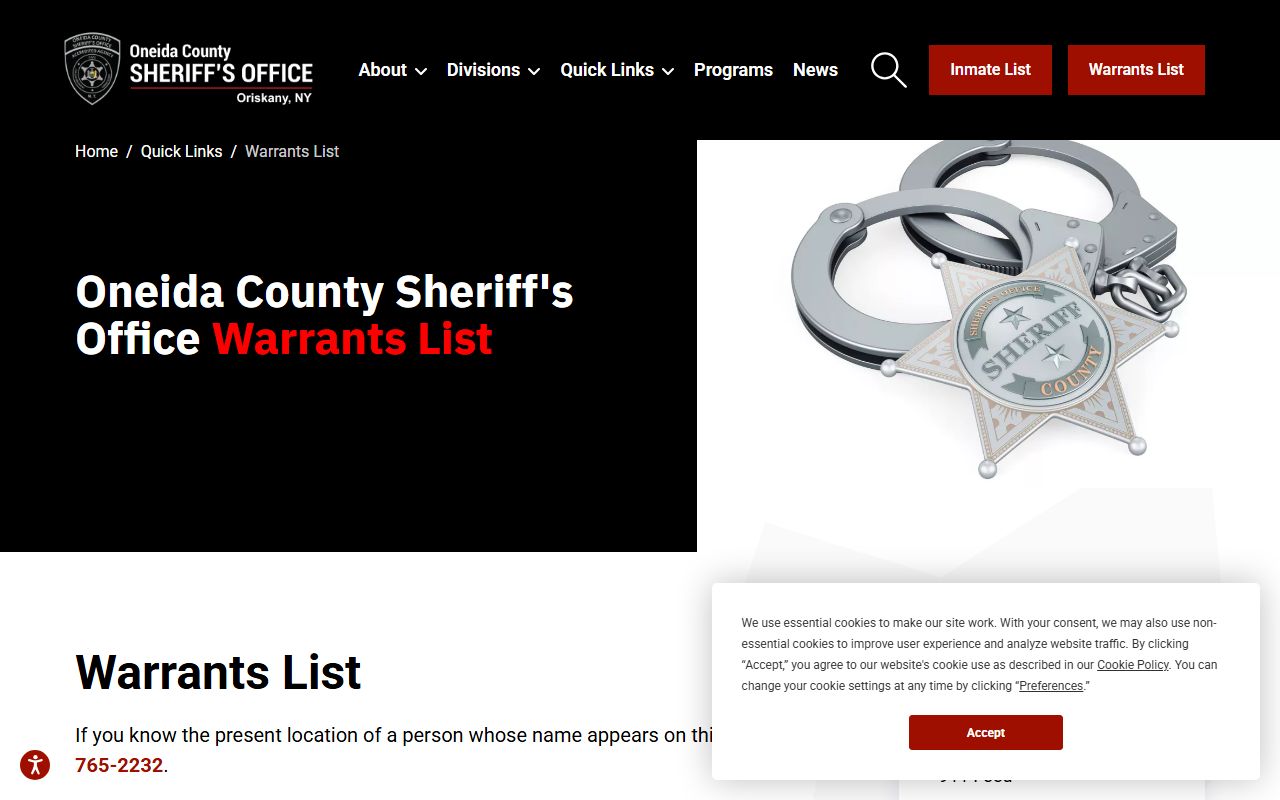
The warrant page helps identify the issuing court and warrant description, while the court record explains what case or proceeding produced the warrant.
An active arrest or bench warrant can lead to a booking at the Oneida County Correctional Facility. Once the person is in custody, the jail record may show a charge or hold tied to the warrant. The warrant list is still the stronger starting point for active-warrant status, while WebCriminal, the issuing court, the County Clerk, or the District Attorney may be needed to understand the underlying court record. If a city, town, or village court warrant is not visible on the Sheriff's list, contact the issuing court or legal counsel rather than assuming no warrant exists.
Charges vs. Convictions
A charge is an accusation. A conviction is a final outcome after a guilty plea, verdict, or qualifying disposition. Court records after an arrest often show both the original charge path and the final result, and those two may be different. A booking charge should never be described as a conviction unless the court record shows a conviction.
| Charge | Conviction | |
|---|---|---|
| Stage | Accusation filed or carried in court | Final guilty plea, verdict, or qualifying disposition |
| Proof | Based on accusatory documents and probable cause standards | Requires proof beyond a reasonable doubt or a valid plea |
| Record Meaning | Shows what was alleged | Shows the outcome that can affect sentence and history |
| Can Change | Yes, by amendment, reduction, dismissal, or indictment | Can be affected by appeal, sealing, or later court order |
Sealed vs. Expunged Arrest and Court Records
New York uses sealing rules for many criminal-record access questions. The research identifies CPL Sec. 160.50 as important when a case terminates in favor of the accused. In that situation, official records are generally sealed. Sealing restricts public access, but it is not the same as saying every trace was destroyed. Expungement is a different concept and should not be promised for Oneida County court records unless a specific New York law or court order supports it.
| Sealed | Expunged | |
|---|---|---|
| Public Access | Restricted from ordinary public inspection | Treated as removed or destroyed where a law allows it |
| New York Use | Common term for restricted criminal records | Do not assume availability without a specific legal basis |
| Example | CPL Sec. 160.50 sealing after favorable termination | Requires a separate statute or order, if available |
| Practical Step | Ask the court or Clerk whether the file is sealed | Consult the court record or an attorney before relying on it |
Background Check Considerations
Public court searches, jail roster checks, OCA CHRS searches, and fingerprint RAP sheets answer different questions. OCA CHRS is a statewide exact-name and date-of-birth criminal-history search with a $95 fee, available online or by mail. DCJS RAP sheets are fingerprint-based and are not the same as browsing public court records after an arrest. For employment, housing, credit, insurance, or other regulated screening, use a legally compliant consumer-reporting process rather than informal court or jail lookups.
Important: This website is not a consumer reporting agency and cannot be used for FCRA-covered screening decisions.
Restricted Court Records After an Arrest in Oneida County
FOIL and public-access rules do not make every criminal record public. The research notes that law-enforcement, privacy, safety, sealing, and booking-photo restrictions can apply. The County Clerk specifically says criminal files are not searchable through the public record website because of confidential information, although unsealed criminal files can be accessed at a County Clerk computer terminal. Juvenile matters, sealed cases, dismissed charges that trigger sealing, active investigations, and records involving protected parties may be unavailable or limited.
The District Attorney's public office page at oneidacountyny.gov/departments/district-attorney/ identifies the prosecution role, office contact information, and countywide criminal-court coverage.
Use the DA information for prosecutor-side context, but use the court or Clerk channel for case-file access and official court-record status.
For prosecutor communications or a FOIL route tied to District Attorney materials, the DA staff page lists Michael A. LaBella as Assistant District Attorney and FOIL Officer. The District Attorney's office is at 235 Elizabeth Street, Utica, NY 13501, phone (315) 798-5766, fax (315) 798-5582, with hours listed as 8:30 AM to 4:30 PM. The DA page lists District Attorney Todd Carville and explains that the office prosecutes crimes against local and state ordinances across Oneida County's many local courts.